Final Draft

Saturday, May 07, 2011


The Untamable Mississippi River

May 7, 2011


The rain-swollen Mississippi River crested to an all-time high last week as it surged past Cairo, Ill., exceeding the 1937 record by 2 feet. Government engineers were left with two choices: Let Cairo flood or explode a levee to save the town. They blew up the levee. But while Cairo was saved, other communities may not be so lucky.

"We're going to fight this river all the way down to the Gulf of Mexico," said Col. Vernie L. Reichling Jr. of the Army Corps of Engineers. The battle against North America's longest river is never-ending, as The Times's Isabel Wilkerson found in 1993, another year of record flooding.

The excerpt below is from a collection of articles that won a Pulitzer Prize.

THERE HAVE BEEN FLOODS BEFORE. People in Hannibal, Mo., or Keokuk, Iowa, or Quincy, Ill., can tell you about watching their fathers and uncles pack sandbags to protect the year's corn crop or the feed store. For generations, some farmers figured floods and droughts into the cost of doing business. But then the country's big plumbing system of levees and dams, made better after every flood, was supposed to keep the rivers in their place and maintain the comfortable paradox of living on a floodplain.

There have been floods before. People in Hannibal, Now the unimaginable has happened. Across the Midwestern cornbelt it has rained in biblical proportions — 49 straight days, often in torrents. The rivers, driven past their banks, have taken back land that long ago was theirs, invading 15 million acres of farmland in eight states, forcing 36,000 people from their homes, halting river traffic for 600 miles and causing billions of dollars in damage.

There have been floods before. People in Hannibal, From the air, from Minnesota to Missouri, from Kansas to Illinois, it looks like someone has spilled gallons and gallons of coffee on a green patchwork quilt that happens to be farms and towns. In silt rivers now wide as lakes, treetops look like bushes in a swimming pool, bridges and highways and other brave monuments to engineering are reduced to thin, threatened slivers, and even their builders know the water could take them, too, if it wanted. The floods have made the broad, S-curved Mississippi and its otherwise perfectly ordered valley look more like the Florida Keys. ...

There have been floods before. People in Hannibal, The river, ecologists and farmers say, was never supposed to follow the tight course humans have expected it to, indeed ordered it to, with their walls of dirt and concrete levees. Of course, that has not stopped people from building homes and farms and cities along the river. The Mississippi Valley's thick black soil is considered the richest on earth, impossible for farmers to resist.

There have been floods before. People in Hannibal, But to claim the land meant making a bargain with the river, confining it to an artificially narrow path so that farms could reach as far as the shore and places like New Orleans and St. Louis could live undisturbed while their goods were carried safely from port to port. The price that river people pay is sudden and catastrophic flooding when excess rainwater, forced into a narrow channel by the levees, runs out of places to go and cannot drain naturally into the soil. ...

There have been floods before. People in Hannibal, The great lesson of the floods may be that humans will have to do a lot more if they are to outwit nature, if that is even possible. — ISABEL WILKERSON


Copyright. 2011. The New York Times Company. All Rights reserved


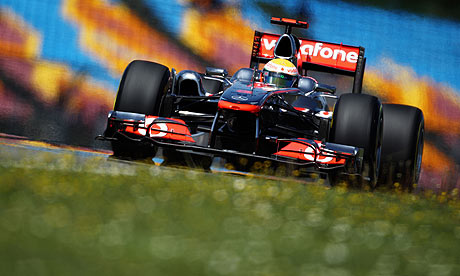
Turkish Grand Prix: Lewis Hamilton is left frustrated by Red Bull


• McLaren driver qualifies fourth, team-mate Button sixth
• Vettel and Webber qualify first and second for Sunday's race


Lewis Hamilton
Lewis Hamilton steers his McLaren to fourth place on the grid in Istanbul during qualifying. Photograph: Paul Gilham/Getty Images

Lewis Hamilton's pessimism when he arrived in Istanbul was partially justified when once again he was kept off the front of the grid by the Red Bull pair of Sebastian Vettel and Mark Webber in a disappointing qualifying session.

With Nico Rosberg's Mercedes taking third place in the line-up for the Turkish Grand Prix, Hamilton was forced down toended up fourth on the grid. His team-mate, Jenson Button, is in sixth place and the McLaren pair were split by Fernando Alonso, who qualified fifth, as he has done for every race this season, prompting his Ferrari principal, Stefano Domenicali, to suggest he must have taken a lease out on the place.

"It's not pole position but it's better than nothing," said Hamilton, the winner in the last outing in China. "I would have hoped for a little bit better. We are in the fight. We don't have an extra set of soft tyres for the race and we've seen that Mercedes and Ferrari have picked up their pace."

At least Martin Whitmarsh, the McLaren team principal, was upbeat about the performance. "It's very tight, very competitive, at the sharp end of the grid this year – and it's worth noting that, had Lewis managed to string together his three best sector times in a single lap, he'd have been second-quickest," he said. "As things turned out, he was fourth-quickest, and Jenson was sixth-quickest, but they're both fantastic racers and they'll approach tomorrow's race with all the controlled aggression that we've come to expect from them."

Button, the winner here two years ago and last year's runner-up, was also looking for positives. "Sixth position isn't great, but we can still do well," he said. "Mark Webber had a good race from 18th in China, so we can definitely have a good race from sixth."

"Maybe I should have just done a single run for Q3 because my second run wasn't any faster than my first – and you tend to lose time if you push these tyres too hard. But, to be honest, I couldn't get a really good balance in qualifying."

Vettel, however, looked problem-free, even though his car sustained serious damage in practicehere yesterday morning. This was his 19th pole position, and his fourth in four races this season equalled the record of McLaren's Mika Hakkinen in 1999. "We had a good day today," the Red Bull driver said, smiling, as he apologised to mechanics and engineers for yesterday's mishap, which compromised the team's preparation for the weekend. "It was not the perfect option," he said. "But I found the rhythm of the track quickly and had a good Q1 and Q2 so we felt confident going into Q3."

But qualifying, which has proved better than the actual race on some occasions, has lost much of its lustre. For one thing, pole means less these days, with overtaking increasing through tyre degradation and DRS, which reduces drag, not to mention the bursts of acceleration KERS allows. And for that reason the teams are now approaching the Saturday afternoon hour more cautiously. It is now all part of the tyre-conservation strategy, for the top 10 drivers must start with the same tyres they used in qualifying.

The most heartening result probably came from Mercedes, though, with Rosberg capping a good two days with third place. But Michael Schumacher, in eighth, was less content. "I'm not happy at all to be so far off," said the seven-times world champion. "We couldn't reproduce what we did this morning. The more I pushed the more things went wrong and I had no grip left."


FW: Qualifying Results for Grand Prix of Turkey, 2011.


In a shocking display of superiority, Sebastian Vettel (1:25.049) took pole for the 2011 Turkish Grand Prix after a single early run in Q3. He and second-place starting teammate Mark Webber simply got out of their Red Bulls and left the rest of the drivers to fight for the starting positions behind them as the minutes ticked away. Nico Rosberg, Lewis Hamilton, and Fernando Alonso completed the fastest five during Saturday's qualifying, while Jenson Button, Vitaly Petrov, Michael Schumacher, Nick Heidfeld, and Felipe Massa will be the top ten starters for Sunday's race. Massa did not set a Q3 time after using an extra set of soft tires just to get out of Q1. It was a bad day (that will likely produce fabulous racing) for Kamui Kobayashi, whose Sauber failed during the early moments of Q1 and was unable to produce a qualifying time.

Friday held both rain and sunshine, though all temperatures were cooler than expected from Istanbul.  Alonso led in the wet during the morning session, followed by Rosberg, Schumacher, Heidfeld, and Petrov. The rain was a bad omen for both Red Bull teammates, as Vettel shunted his way out of the entire day's running and Webber finished the session only eleventh fastest. It was Alonso who was eleventh fastest in the dry and sometimes sunny afternoon session, fouled by a hydraulic leak and inexplicably odd-sounding engine notes. Button was the leader in the second practice, followed by a phalanx of Mercedes engines: Rosberg, Hamilton, and Schumacher, with Webber fifth fastest.

Saturday morning dawned sunny but still cooler than usual for the final practice, with Vettel (1:26.037) making the most of his limited time on track to go quickest of the weekend. He led Schumacher by just a thousandth, with Webber, Rosberg, and Button keeping McLaren and Mercedes the best of the rest. Alonso's woes continued, ending his session early after some sort of power loss just as soft tires came into play. The team had to rebuild the car before qualifying and changed Massa's engine as a precaution in the break as well. Virgin Racing's Jerome D'Ambrosio will be penalized five starting positions from his qualifying position after going too quickly for yellow flag conditions during the Friday afternoon practice. He set a personal best sector time while passing yellow flags for Maldonado's incident near the end of that session.

Q1:
The temperature was much warmer in Istanbul for the afternoon qualify session, and just as important, the sun was shining brightly as Kobayashi led the way onto the track for the twenty minute Q1 session. Liuzzi (1:32.524) was the first to set a time, soon bettered by D'Ambrosio. Kobayashi did not fare well, returning to the garage slowly and possibly not under his own power. Soon, the Force Indias of di Resta (1:29.223) and Sutil led the way over D'Ambrosio, Glock, Schumacher, and Liuzzi. However, Vettel's first lap put him at the top with a 1:27.039. Alonso was second, only to be eclipsed by Buemi. Times continued to drop as more drivers began their hot laps

Vettel led Webber, Rosberg, Buemi, and Alonso halfway through the session, with Liuzzi, Hamilton, Button, Kobayashi, Perez, Heidfeld, and Petrov in the knockout zone. Both McLarens had set times, but only slow ones. On their first proper laps, they slotted into third and fourth, with Hamilton over three tenths quicker than his teammate. With seven minutes to go, most drivers were back in the garage.  Only Perez, Liuzzi, Heidfeld, and Petrov were out with five minutes remaining. Petrov went fifth fastest on his first timed lap, while Heidfeld was only eleventh fastest. Some of the other slower drivers made their way back onto the track, leaving di Resta and Kobayashi with the "new" teams in the relegation zone.

Massa was also well down the order, only fifteenth fastest. He soon dropped to sixteenth ans was circulating on soft tires in an effort to move beyond Q1, going fastest (but only .046s faster than Vettel, who was on the harder tire). Alonso moved up to fifth from eleventh, keeping himself safe for Q2. Kovalainen nearly dropped Sutil out in Q1, but the Lotus was not quite there. Sutil himself was able to move up to seventh across the line. At the end of Q1, Massa (1:27.013) was fastest, followed by Vettel, Webber, Hamilton, Alonso, Button, Sutil, Maldonado, Petrov, and Rosberg as the fastest ten. Though Kobayashi did not technically qualify, he will likely race at the discretion of the stewards. In explanation for Trulli's much slower pace than Kovalainen's, Mike Gascoyne tweeted, "Jarno had no DRS for qualifying…Will be fixed for the race."

Knocked Out in Q1:
18. Kovalainen
19. Trulli
20. D'Ambrosio
21. Liuzzi
22. Glock
23. Karthikeyan
24. Kobayashi

Q2:
Schumacher was first out for Q2, quickly followed by more than half of the field. Five minutes into the fifteen minute session, Webber (1:26.075) led Barrichello, Schumacher, Petrov, and Sutil. That would soon change, with more drivers using the softer tires. Vettel (1:25.610) led at the halfway point, with Hamilton, Webber, Alonso Button, Massa, Rosberg, Perez, Buemi, and Barrichello the fastest ten. di Resta had yet to set a time and was joined in the knockout zone by Schumacher, Petrov, Maldonado, Alguersuari, Sutil, and Heidfeld.

Twelfth fastest Petrov was the only driver on the track with five minutes to go. Schumacher joined him as di Resta readied for a single soft tire run. The Russian went sixth fastest on his next lap, with all but the top five drivers and Alguersuari on the track, and two minutes remaining. Schumacher moved up to fourth, while he was inexplicably told "magic paddle latched." Teammate Rosberg moved up to second fastest, leaving Sutil, di Resta, Maldonado, Perez, Buemi, Alguersuari, and Heidfeld in the knockout zone with no time left. Heidfeld moved up to tenth, pushing Barrichello out. di Resta was also knocked out as Massa improved to seventh. In the end, Vettel, Rosberg, Hamilton, Webber, Schumacher, Alonso, Massa, Button, Petrov, and Heidfeld were the fastest ten moving on to fight for pole.

Knocked Out in Q2:
11. Barrichello
12. Sutil
13. di Resta
14. Maldonado
15. Perez
16. Buemi
17. Alguersuari

Q3:
Petrov was out on soft tires straightaway, followed by Button then Alonso as the ten minutes of Q3 began. The Russian's time (1:26.411) was first up, though both Red Bulls and both McLarens were also on track. Button, then Alonso (1:25.851) took the top spot, only to have Webber take it away. Hamilton soon slid into second fastest. Vettel (1:25.049) was quickest by four tenths on his first fast lap, leading Webber, Hamilton, Alonso, Button, and Petrov as the top six with less than five minutes remaining.

Massa, Schumacher, Rosberg, and Heidfeld still had not set a time with four minutes to go. No one was on track when three minutes were left. Soon thereafter, Massa, Rosberg, Heidfeld, Schumacher, and Alonso were back out, joined by the McLarens. With two minutes, only the Red Bulls remained in the garage. Vettel climbed out of the car with a minute to go, leaving his time to stand and saving tires. Webber also stayed in the garage. Rosberg stayed third on his final lap, while Alonso aborted his, as did Massa. Schumacher was eighth, while Button was only able to make sixth, and Hamilton remained fourth.

Final Qualifying Times for the 2011 Turkish Grand Prix:

 DriverTeamTimeLaps
1.Sebastian VettelRed Bull1:25.04912
2.Mark WebberRed Bull1:25.45410
3.Nico RosbergMercedes GP1:25.57415
4.Lewis HamiltonMcLaren1:25.59513
5.Fernando AlonsoFerrari1:25.85116
6.Jenson ButtonMcLaren1:25.98214
7.Vitaly PetrovRenault1:25.29615
8.Michael SchumacherMercedes GP1:26.64613
9.Nick HeidfeldRenault1:26.65913
10.Felipe MassaFerrari1:26.76416
11.Rubens BarrichelloWilliams1:26.76410
12.Adrian SutilForce India1:27.02714
13.Paul di RestaForce India1:27.14511
14.Pastor MaldonadoWilliams1:27.23614
15.Sergio PerezSauber1:27.24411
16.Sebastien BuemiToro Rosso1:27.2559
17.Jaime AlguersuariToro Rosso1:27.5727
18.Heikki KovalainenLotus1:28.7808
19.Jarno TrulliLotus1:30.1198
20.Tonio LiuzziHRT1:30.6927
21.Timo GlockVirgin Racing1:30.8138
22.Narain KarthikeyanHRT1:31.5648
23.Kamui Kobayashi*SauberN/T2
24.Jerome D'Ambrosio**Virgin Racing1:30.4458

*at the discretion of stewards
**after 5 place penalty for driving too quickly under yellow flag


Copyright© 2005-2010. Formula1blog.com


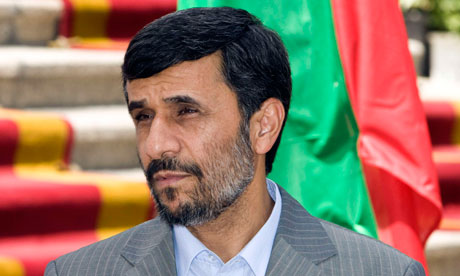
FW: Iran's supreme leader tells Ahmadinejad: accept minister or quit


Mahmoud Ahmadinejad

Iran's president Mahmoud Ahmadinejad has declined to officially support the supreme leader's reinstatement of a minister. Photograph: Raheb Homavandi/Reuters

An unprecedented power struggle at the heart of the Iranian regime has intensified after it emerged that the supreme leader, Ali Khamenei, had given an ultimatum to PresidentMahmoud Ahmadinejad to accept his intervention in a cabinet appointment or resign.

A member of the Iranian parliament, Morteza Agha-Tehrani – who is described as "Ahmadinejad's moral adviser" – told a gathering of his supporters on Friday that a meeting between Ahmadinejad and Khamenei had recently taken place, in which the president was given a deadline to resign or to accept the decision of the ayatollah.

The extraordinary confrontation came to light after Ahmadinejad declined to officially support Khamenei's reinstatement of a minister whom the president had initially asked to resign.

The rift between the two men grew when the president staged an 11-day walkout in an apparent protest at Khamenei's decision. In the first cabinet meeting since ending his protest, the intelligence minister at the centre of the row, Heydar Moslehi, was absent and in the second one on Wednesday, he was reportedly asked by Ahmadinejad to leave.

In a video released on Iranian websites, Agha-Tehrani quotes Ahmadinejad as saying: "[Khamenei] gave me a deadline to make up my mind. I would either accept [the reinstatement] or resign."

Although Khamenei is not constitutionally allowed to intervene in cabinet appointments, an unwritten law requires all officials to always abide by the supreme leader without showing any opposition.

Clerics close to Khamenei have launched a campaign to highlight his role in Iranian politics, saying that to disobey him is equal to apostasy, as he is "God's representative on earth".

Meanwhile, the president was reportedly absent from religious ceremonies this week at Khamenei's house, where he was publicly criticised by close allies of the ayatollah. Iranian officials are traditionally required to participate in such ceremonies in order to cover up any political rift that might compromise Khamenei's power.

Iran's semi-official Mehr news agency reported on Thursday that several members of parliament had revived a bid to summon Ahmadinejad for questioning over "the recent events". It said 90 MPs had signed the petition, up from only 12 last week.

Under Iranian law, at least 85 more signatures are required for a possible impeachment of the president.

Supporters of Khamenei say that Ahmadinejad is surrounded by "deviants" in his inner circle, including his controversial chief of staff, Esfandiar Rahim Mashaei, who wants to undermine the involvement of clerics in Iran's politics. Mashaei and his allies have recently been accused of using supernatural powers and invoking djinns (spirits) in pursuing the government's policies.

On Thursday, the commander of the powerful revolutionary guards, Mohammad Ali Jafari, was quoted by the semi-official Fars news agency as saying: "People [close to Khamenei] are not relying on djinns, fairies and demons ... and they will not stand any deviation [of the government in this regime]."

Iran's elite revolutionary guards, who played an important role in securing Ahmadinejad a second term in Iran's 2009 "rigged" elections, have distanced themselves from Ahmadinejad in recent months as Mashaei's "secular" views have become more pronounced. In the face of these recent confrontation with Khamenei, Ahmadinejad has been left isolated, with only a handful of serious supporters.Iran's opposition, exhausted by the brutal crackdown of the green movement and the placing of its leaders Mir Hossein Mousavi and Mehdi Karroubi under house arrest in the past 80 days, has found itself watching these recent developments and wondering what will happen next.


FW: CBS Reporter Recounts ‘Merciless’ Assault in Egypt


Chester Higgins Jr./The New York Times

Lara Logan, chief foreign affairs correspondent and correspondent for CBS's "60 Minutes," on her first day back to work since being beaten and sexually assaulted by a mob in Cairo's Tahrir Square the day Egyptian President Mubarak stepped down.


April 28, 2011

CBS Reporter Recounts 'Merciless' Assault in Egypt

By 

Lara Logan thought she was going to die in Tahrir Square when she was sexually assaulted by a mob on the night that Hosni Mubarak's government fell in Cairo.

Ms. Logan, a CBS News correspondent, was in the square preparing a report for "60 Minutes" on Feb. 11 when the celebratory mood suddenly turned threatening. She was ripped away from her producer and bodyguard by a group of men who tore at her clothes and groped and beat her body. "For an extended period of time, they raped me with their hands," Ms. Logan said in an interview with The New York Times. She estimated that the attack lasted for about 40 minutes and involved 200 to 300 men.

Ms. Logan, who returned to work this month, is expected to speak at length about the assault on the CBS News program "60 Minutes" on Sunday night.

Her experience in Cairo underscored the fact that female journalists often face a different kind of violence. While other forms of physical violence affecting journalists are widely covered — the traumatic brain injury suffered by the ABC News anchor Bob Woodruff in Iraq in 2006 was a front-page story at that time — sexual threats against women are rarely talked about within journalistic circles or in the news media.

With sexual violence, "you only have your word," Ms. Logan said in the interview. "The physical wounds heal. You don't carry around the evidence the way you would if you had lost your leg or your arm in Afghanistan."

Little research has been conducted about the prevalence of sexual violence affecting journalists in conflict zones. But in the weeks following Ms. Logan's assault, other women recounted being harassed and assaulted while working overseas, and groups like the Committee to Project Journalists said they would revise their handbooks to better address sexual assault.

Jeff Fager, the chairman of CBS News and the executive producer of "60 Minutes," said that the forthcoming segment about the assault on Ms. Logan would raise awareness of the issue. "There's a code of silence about it that I think is in Lara's interest and in our interest to break," he said.

Until now the only public comment about the assault came four days after it took place, when Ms. Logan was still in the hospital. She and Mr. Fager drafted a short statement that she had "suffered a brutal and sustained sexual assault and beating."

That statement, Ms. Logan said, "didn't leave me to carry the burden alone, like my dirty little secret, something that I had to be ashamed of."

The assault happened the day that Ms. Logan returned to Cairo, having left a week earlier after being detained and interrogated by Egyptian forces. "The city was on fire with celebration" over Mr. Mubarak's exit, she said, comparing it to a Super Bowl party. She and a camera crew traversed Tahrir Square, the epicenter of the celebrations, interviewing Egyptians and posing for photographs with people who wanted to be seen with an American journalist.

"There was a moment that everything went wrong," she recalled.

As the cameraman, Richard Butler, was swapping out a battery, Egyptian colleagues who were accompanying the camera crew heard men nearby talking about wanting to take Ms. Logan's pants off. She said: "Our local people with us said, 'We've gotta get out of here.' That was literally the moment the mob set on me."

Mr. Butler, Ms. Logan's producer, Max McClellan, and two locally hired drivers were "helpless," Mr. Fager said, "because the mob was just so powerful." A bodyguard who had been hired to accompany the team was able to stay with Ms. Logan for a brief period of time.

"For Max," the producer, "to see the bodyguard come out of the pile without her, that was one of the worst parts," Mr. Fager said. He said Ms. Logan "described how her hand was sore for days after — and the she realized it was from holding on so tight" to the bodyguard's hand.

"My clothes were torn to pieces," Ms. Logan said.

She declined to go into more detail about the assault but said: "What really struck me was how merciless they were. They really enjoyed my pain and suffering. It incited them to more violence."

After being rescued by a group of civilians and Egyptian soldiers, she was swiftly flown back to the United States. "She was quite traumatized, as you can imagine, for a period of time," Mr. Fager said. Ms. Logan said she decided almost immediately that she would speak out about sexual violence both on behalf of other journalists and on behalf of "millions of voiceless women who are subjected to attacks like this and worse."

More than a dozen journalists have been detained in Libya in the past two months, including four who were working for The Times. One of the Times journalists, Lynsey Addario, said she was repeatedly groped and harassed by her Libyan captors.

For Ms. Logan, learning about Ms. Addario's experience was a "setback" in her recovery. While Ms. Logan, CBS's chief foreign affairs correspondent, said she would definitely return to Afghanistan and other conflict zones, she said she had decided — for the moment — not to report from the Middle Eastern countries where protests were widespread. "The very nature of what we do — communicating information — is what's undoing these regimes," she said. "It makes us the enemy, whether we like it or not."

Before the assault, Ms. Logan said, she did not know about the levels of harassment and abuse that women in Egypt and other countries regularly experienced. "I would have paid more attention to it if I had had any sense of it," she said. "When women are harassed and subjected to this in society, they're denied an equal place in that society. Public spaces don't belong to them. Men control it. It reaffirms the oppressive role of men in the society."

After the "60 Minutes" segment is broadcast, though, she does not intend to give other interviews on the subject. "I don't want this to define me," she said.

She said that the kindness and support shown by Mr. Fager and others at CBS and by strangers — like the high school class in Texas and the group of women at ABC News who wrote letters to her — was a "very big part of picking myself up and restoring my dignity and my self-worth."

Among the letters she received, she said, was one from a woman who lives in Canada who was raped in the back of a taxi cab in Cairo in early February, amid the protests there. "That poor woman had to go into the airport begging people to help her," Ms. Logan recalled. When she returned home, "her family told her not to talk about it."

Ms. Logan said that as she read the letter, she started to sob. "It was a reminder to me of how fortunate I was," she said.


Copyright. 2011 The New York Times Company. All Rights Reserved.


Her Imperial Majesty Soraya


ANSWER: My husband, Mohammad Reza Pahlvai, was Shah of Iran for 37 eventful years. I received that 23 carat ring in 1949 and we married 18 months later. 
Until our divorce in 1958, I was known as Her Imperial Majesty Queen Soraya.
His reign was marked by unprecedented increases in living standards. Literacy skyrocketed and all children were fed in public schools.
He banned child marriage, polygamy and segregated education. The Shah never told women how to dress.
He was a wonderful friend of the United States and two of the major boulevards in Tehran were then known as Eisenhower and Kennedy. Of course, that hurt him with fundamentalists. The Shah had a secret police, SAVAK, and there were over 2000 political prisoners.
Nevertheless, his oppression is minor compared to today. Most of those prisoners were terrorists and they deserved to be in jail. As my husband often said: "When Iranians learn to behave like Swedes, I will behave like the King of Sweden."
In my era, Iran was not an Islamic republic and the Shah was always a secular Muslim.
He was the first Muslim leader to recognize Israel, and to make a state visit to Israel. Oil profits allowed him to build a large military. Half the weapons came from America, and the other half came from Israel. His eldest sister, Princess Shams, proposed to me on his behalf, and decades later we both became Catholics.
The Shah's first wife, Princess Fawzia of Egypt, is still alive today at age 89. She hated Tehran and always expressed a preference for Cairo, which continues to be her home.
As indicated in my 1964 memoir, "Princess Soraya: Autobiography of Her Imperial Highness", we had a good marriage. The "worst person in the world" who gave me that mink coat was Joseph Stalin.
The big problem was my inability to become pregnant. The Shah accepted the situation because he had a brother. If I did not have a child, continuation of the Pahlavi dynasty was assured through his brother and his brother's eventual children. That is the situation in Japan today where the Crown Princess has never had a child.
One of the worst days of my life was October 17, 1954 when Prince Ali Reza, 32, was killed in a plane crash. The Shah's brother had never married and there was no heir. We consulted the best doctors in the world but I was infertile.
I later told "The New York Times" the Shah had no choice but to divorce me. He was crying when he announced our divorce on television in 1958.
The Shah said he still loved me, and I believed him. He offered to continue our marriage but wanted to take a second wife who could produce an heir. I turned him down.
I was not yet 26, and I lived until 69, but never remarried. After the divorce I spent the next 44 years in Paris, and never had any financial problems. I did have a serious problem with depression.
For two decades the Shah's third wife lived near me in Paris, but it was just too painful for me to meet her. Similar to Kate Middleton, many women envied me and the royal lifestyle. What they forget is that there were two attempts to assassinate the Shah, and I suffered from manic depression for four decades. The same illness impacted two of the Shah's children, and they both committed suicide at a young age.
My name is Soraya Esfandiary-Bakhtiari (June 22, 1932 – October 26, 2001), Princess of Iran.


Copyright.Historical Trivia Questions by Gregg Hilton. All Rights reserved

Archives

December 2005   October 2010   November 2010   May 2011   June 2011   February 2013   March 2013   April 2013   November 2013   May 2014   June 2014   August 2014  

This page is powered by Blogger. Isn't yours?